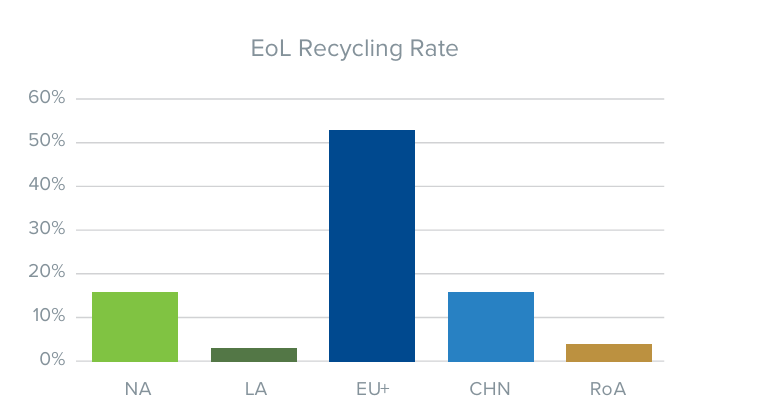
The European Union achieves a zinc end-of-life recycling rate exceeding 50%—significantly above the recycling rate of other regions. Even China and North America have a zinc end-of-life recycling rate between 10-20%, while other regions perform at ca 5% zinc end-of-life recycling rate.
Picture source: IZA
A Regulatory Framework Built for Circularity
The EU’s higher zinc recycling rate is fundamentally rooted in its regulatory approach to critical materials. The Critical Raw Materials Act (CRMA), adopted in 2023 and strengthened through subsequent legislative measures, establishes binding collection and recovery requirements while setting a non-binding target that at least 25% of the EU’s strategic raw materials should originate from recycled sources by 2030.
Regulatory Infrastructure for Zinc Recovery from Galvanised Steel
Galvanised steel is the largest zinc application, and it is notoriously difficult to recover zinc from EoL galvanised steel. When steel containing galvanised coatings is recycled in an Electric Arc Furnace (EAF), the zinc vaporizes and is captured as zinc oxide dust. Outside the EU, this dust is frequently treated as hazardous waste and landfilled.
The EU has developed specialized infrastructure for this most challenging zinc recycling application: via a network of specialized facilities employing the Waelz Kiln process, which concentrates and recovers zinc from furnace dust into a high-purity feedstock for zinc refineries. This infrastructure exists in the EU because regulatory requirements and long-term policy certainty made the investment justifiable.
EU regulations that create this environment:
- The Waste Framework Directive (2008/98/EC): This is the cornerstone of EU waste policy as establishes the waste hierarchy, which legally prioritizes recycling and recovery over disposal (landfilling). This allows the zinc oxide recovered from the furnace dust to be reclassified as a valuable product, justifying the investment in recovery infrastructure.
- The Landfill Directive (1999/31/EC): This directive severely restricts the landfilling of hazardous waste—which EAF dust is classified as. By making the traditional disposal route prohibitively expensive and difficult, it creates a powerful financial incentive for steel producers to find alternative solutions for their furnace dust.
- The Industrial Emissions Directive (IED) (2010/75/EU):This regulation governs pollution from industrial installations, including steel plants. It requires facilities to use the Best Available Techniques (BAT) to minimize their environmental impact. It explicitly identify the recovery of zinc from EAF dust as a best practice.
Other regulations relevant for zinc recycling
- End-of-Life Vehicles (ELV) Directive
The ELV Directive applies to all cars and light commercial vehicles and mandates 95% recovery by weight for automobiles. The primary goal is to increase the rate of reuse, recycling, and recovery of materials. Key applications of zinc covered include:
- Galvanised Steel: This is the largest use of zinc in vehicles.
- Zinc Die-Casting: Used for precision parts that require strength and durability, such as door handles, locks, window winding mechanisms, and components for engine and fuel systems.
- Brass: As an alloy of copper and zinc, brass is used for electrical connectors, terminals, and fittings in the radiator and cooling systems.
2. Waste Electrical and Electronic Equipment (WEEE) Directive
- Corrosion Protection: Galvanized steel is frequently used for the casings and structural frames of larger appliances
- Brass Components: Used extensively for electrical connectors, plugs, sockets, and internal wiring terminals.
- Die-Cast Components: Zinc die-casting is used for creating heat sinks, frames for screens, and other structural parts in consumer electronics.
- Batteries: Zinc is a key component in various types of batteries, including zinc-carbon, alkaline, and zinc-air batteries, which are all covered by battery-specific regulations linked to the WEEE directive.
What Other Regions Lack
Regions outside the EU exhibit significantly lower zinc recycling rates because they lack a comprehensive regulatory framework comparable to Europe’s integrated approach. These regions typically operate without mandatory recovery targets for zinc, meaning zinc recovery remains optional rather than legally required. Without long-term policy certainty, investors cannot justify the enormous capital expenditure required for specialised recovery facilities like Waelz Kiln plants.
Many regions also permit unrestricted waste exports, which removes zinc-containing scrap streams that could feed domestic recycling infrastructure. Consequently, zinc recovery remains purely market-driven in these regions, where the high cost of recycling cannot compete with cheaper alternatives like landfilling or waste export to regions with lower environmental standards.
Summary- Policy Drive
The EU’s superior zinc recycling performance is fundamentally a result of regulatory mandates and policy certainty, not technological superiority. By creating binding recovery targets, restricting disposal routes, and requiring best-practice techniques, EU policy has made advanced zinc recovery economically viable and necessary.
The EU’s experience demonstrates that transforming zinc from a disposed hazardous waste into a valuable secondary raw material requires not just technical capability, but deliberate, sustained regulatory commitment to circularity.