Zinc has a significantly lower global End-of-Life (EoL) recycling rate of approximately 40% compared to Steel (85-90%), Aluminum (75%), and Copper (65%). The primary reason for zinc’s lower recycling rate is not the metal’s inherent recyclability—it is 100% recyclable without quality loss—but rather the way the metal is used across industries.
Why Zinc’s Application Profile Limits Recovery
The largest zinc application is galvanised steel, which accounts for over 60% of global zinc demand. In this use, zinc serves as a protective coating on steel and is difficult to separate during the recycling process. When galvanized steel is recycled in an Electric Arc Furnace (EAF), the zinc coating vaporizes and ends up as zinc oxide dust. Recovery of zinc from this mixed dust stream is hazardous and costly, and in many regions outside the EU, this dust is treated as waste rather than a recoverable resource.
Zinc in brass and bronze (approximately 11% of demand) similarly ends up in the copper recycling cycle and is not recovered as zinc.
Zinc chemicals, primarily zinc oxide (8% of demand), disappear into disparate applications including paints, cosmetics, and rubber manufacturing, making recovery impractical.
This application profile leaves the industry with a focused opportunity: recycling zinc die-casting end-of-life products, which represent approximately 15% of zinc demand, along with rolled zinc sheets used in architectural applications (5% of demand). These two categories represent technically and economically viable global recycling improvement targets.
The Zinc Die-Casting Opportunity
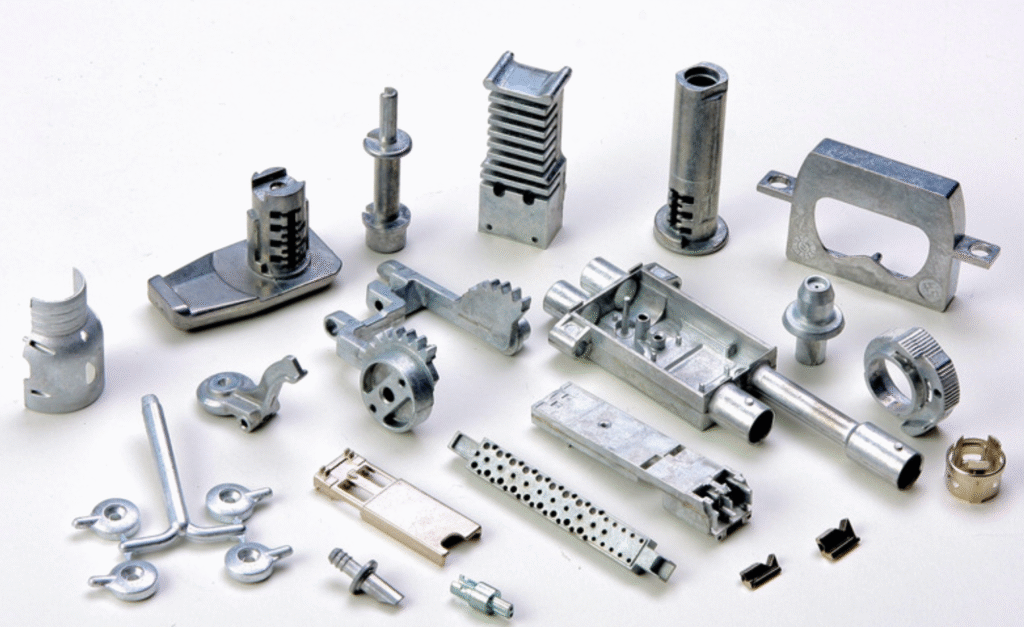
Zinc die-casting produces precise, corrosion-resistant components for automotive, electronics, hardware, and consumer goods using high-percentage zinc alloys such as Zamak or ZA series. These die-cast products are theoretically well-suited for recycling: they are relatively easy to disassemble and are 100% recyclable without mechanical property degradation.
However, post-consumer recovery of distributed die-cast parts remains low, with industry sources commonly reporting recovery rates between 20–40%. This gap between theoretical potential and actual practice reveals fundamental barriers to efficient zinc die-casting recycling.
Primary Barriers to Zinc Die-Casting Recycling
- Contamination challenges
Many die-cast parts are assembled with plastics, rubber, adhesives, steel inserts, or coated finishes. These non-metallic and mixed metal attachments complicate sorting and remelting, degrading recycled metal quality. Surface treatments such as electroplating, paints, and powder coatings introduce organics and heavy metals that generate hazardous off-gases and dross during remelting. Removal of these contaminants adds significant cost and creates additional waste streams.
- Alloy variability
Die-cast alloys vary widely between Zamak and ZA series formulations, and older components may contain lead or cadmium. Uncontrolled mixing of scrap alloys alters chemistry and mechanical properties. Consequently, foundries must assay and blend scrap with primary metal to maintain specifications—a process that reduces the economic advantage of recycling.
- Logistics and economics
Zinc scrap commands moderate market values and die-cast parts are small and widely dispersed across multiple product categories. Collecting these scattered components and recovering relatively modest zinc content—often interspersed with more abundant metals—can prove uneconomical without aggregation incentives or regulatory drivers.
Photo source: richconn.com
The European Model: Overcoming These Barriers
The European Union has demonstrated that these barriers are not insurmountable. The EU achieves EoL zinc recycling rates exceeding 50%—significantly above the global average of 40%—through a systematic, multi-faceted approach.
The EU employs two critical directives that fundamentally reshape recycling economics for diecasted products:
- The End-of-Life Vehicles (ELV) Directive mandates that automotive manufacturers are responsible for the recovery and recycling of the vehicles they produce, with a target of 95% recovery by weight. Since vehicles are major users of both galvanized steel and zinc die-cast alloys, this directive compels the entire recycling chain to develop systems that capture these materials.
- The Waste Electrical and Electronic Equipment (WEEE) Directive applies the same principle of Extended Producer Responsibility to electronics, ensuring that zinc-containing components are collected and processed rather than sent to landfills.
These regulatory requirements create a non-negotiable economic incentive to invest in collection, sorting, and processing technology that might otherwise be uneconomical based purely on market scrap values.
Conclusion
Zinc die-casting represents a significant but underutilized recycling opportunity. By combining regulatory incentives and technological investment, the EU has demonstrated how to overcome recycling challenges.