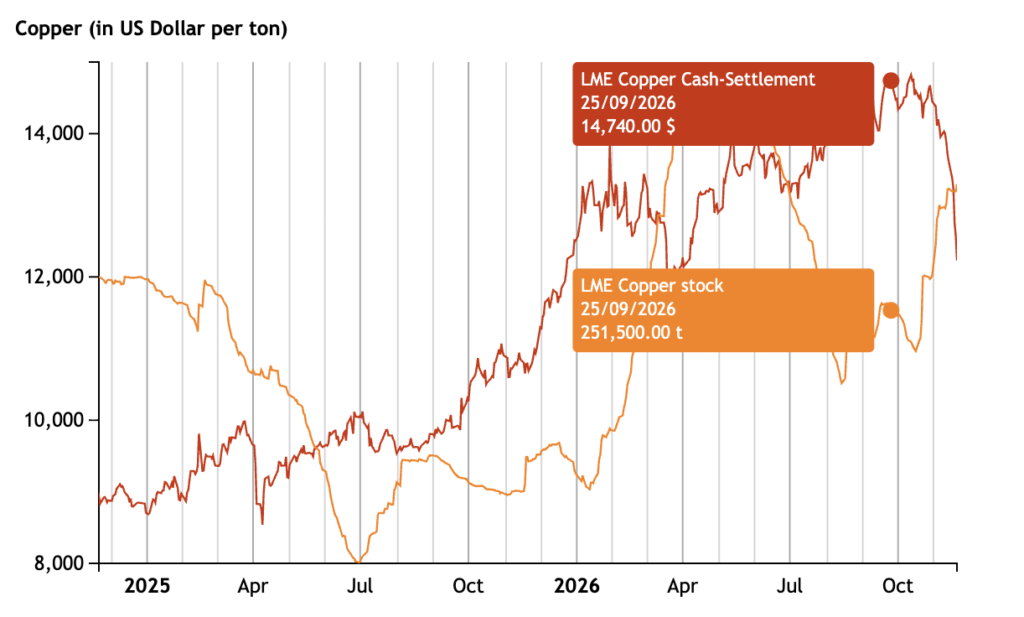
Copper’s sharp decline is primarily a reversal in AI expectations. After reaching a record high roughly ten weeks ago, the metal has entered a bear market as investors unwind bets on an AI-led demand boom, stronger Chinese consumption and possible U.S. tariff disruption.
The AI forecast is unwinding
Copper rallied on expectations that rapid data-centre construction would create enormous additional demand for wiring, power systems, transformers and cooling equipment. The market, however, may have priced in an unrealistically fast and profitable AI expansion.
Investors are now questioning whether AI companies can justify the huge, debt-financed investment required to build new infrastructure. Grid constraints, high construction costs, uncertain returns and possible delays could limit the number of data centres built. If AI demand grows more slowly than expected, less copper will be needed in the near term than bullish forecasts assumed.
Against the backdrop of declining AI-company valuations, investors sold about billion of Comex copper futures in the week ending November 10. Once prices fell through technical support levels, computer-driven funds and other traders intensified the selling, creating a self-reinforcing decline.
Chinese demand is weak—but physical supply is tight
Weak Chinese economic data has added to concerns about industrial demand. China is the world’s largest copper consumer, and softer manufacturing, construction and investment activity can quickly affect global prices. Participants at Asia Copper Week reportedly described demand as “recessionary-like.”
Yet the physical market in China presents a contrasting picture. Chinese buyers have paid exceptionally high premiums for prompt copper, while Shanghai Futures Exchange inventories have fallen sharply.
This apparent contradiction may mean that immediate supplies are scarce even though underlying consumption is weak. Physical tightness could eventually create a price floor once speculative selling has run its course.
The takeaway
The sell-off reflects a valuation and positioning reset rather than the collapse of copper’s long-term fundamentals. Grid expansion, renewable energy, electric vehicles and data centres will continue to require substantial quantities of the metal. However, the market had priced in an exceptionally rapid AI boom, and that expectation is now being reconsidered.